He Takes What Is Broken and Turns it in to Something Gloriouse
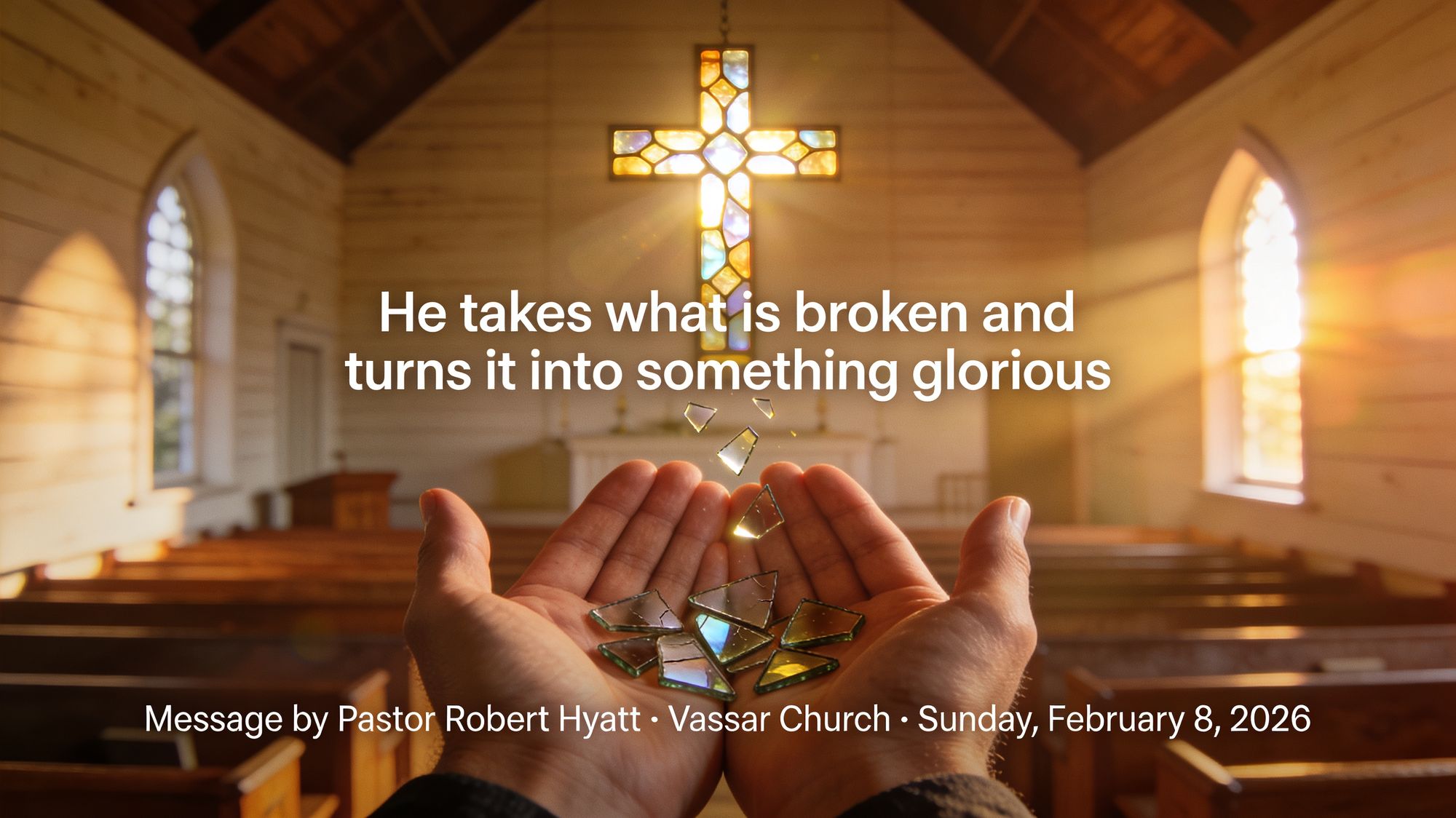
He takes what is broken and turns it into something glorious, By Pastor Robert Hyatt Sunday February 8, 2026 Every believer must understand this unchanging truth: He takes what is broken and turns it into something glorious. That statement reveals the very heart of redemption through Jesus Christ. The cross of Christ is the greatest portrait of divine restoration ever displayed before mankind. On that lonely hill called Calvary, the world saw brokenness and defeat, but Heaven saw victory. “And when they had come to the place called Calvary, there they crucified Him, and the criminals, one on the right hand and the other on the left” (Luke 23:33, NKJV). To human eyes, it looked as though all was lost—His body torn, His blood poured out, His disciples scattered in despair. Yet God’s glorious plan was unfolding. Out of what appeared broken and crushed came salvation, healing, forgiveness, and resurrection power.The cross is proof that God can bring beauty out of suffering. From death came life, from shame came glory, from despair came eternal hope. That is why the Apostle Paul could say, “But we have this treasure in earthen vessels, that the excellence of the power may be of God and not of us” (2 Corinthians 4:7, NKJV). Paul understood that we are fragile vessels—imperfect, easily cracked—but within us is a divine treasure. God does not despise our weakness. Instead, He uses it as a stage upon which His power can shine. He places His glory in human vessels so that when miracles come forth, there is no doubt that it was His hand and not our own striving. When faith rises above feelings, the believer learns to trust God beyond the natural. Feelings change like wind and weather, but faith stands firm in who God is.Think of Peter, the disciple known for his zeal and passion, but also for his failure. He was the one who boldly declared his allegiance to Christ, saying, “Even if I have to die with You, I will not deny You!” (Matthew 26:35, NKJV). Yet within hours, fear overcame him. As he stood in the courtyard, accused of being one of Jesus’ followers, the pressure of the moment caused him to deny the Lord three times. “Then he began to curse and swear, saying, ‘I do not know the Man!’ Immediately a rooster crowed. And Peter remembered the word of Jesus... So he went out and wept bitterly” (Matthew 26:74–75, NKJV). In that moment, Peter was broken. His self-confidence collapsed. His heart grieved the weight of his own weakness.But the story did not end there. After Jesus rose from the dead, He sought out Peter personally on the shores of Galilee. The Lord, full of mercy, asked him three times, “Simon, son of Jonah, do you love Me?” and Peter replied, “Yes, Lord; You know that I love You.” Jesus said to him, “Feed My sheep” (John 21:17, NKJV). In that conversation, Peter’s failure was met by grace. The same mouth that once denied the Savior would soon declare His Word to the nations. That broken fisherman would preach on the day of Pentecost, and three thousand souls would be saved (Acts 2:41, NKJV). God turned Peter’s brokenness into boldness, his shame into strength, and his regret into revival.When the Lord restores a person, He never merely repairs them. He rebuilds them stronger, wiser, and humbler, so they can lead others into faith. Brokenness is the birthplace of spiritual power. It removes pride and replaces it with dependency upon God. Just as gold is purified by fire, so faith is refined through testing. Peter learned to walk by faith, not by emotion or circumstance. Faith must rule the heart more than feelings can move it.In another scene, Jesus demonstrated the divine order of blessing, breaking, and giving. The Gospel records, “Then He commanded the multitudes to sit down on the grass. And He took the five loaves and the two fish, and looking up to heaven, He blessed and broke and gave the loaves to the disciples; and the disciples gave to the multitudes” (Matthew 14:19, NKJV). Notice the divine rhythm: He blessed, He broke, and then He gave. Something blessed must still be broken before it can become a blessing to others. The bread fed multitudes only after it was broken. Likewise, when God allows our lives to be broken, it is not to destroy us but to distribute us—to use us more effectively for His kingdom.Sometimes believers wonder why a season of life feels difficult, why prayers seem delayed, or why doors appear closed. It may be that God is preparing the vessel for greater use. The breaking releases multiplication. Your surrender allows Him to expand what He has placed inside you. Faith must grow even when feelings waver, because the breaking process does not mean God is absent—it means He is at work.A moving story tells of a craftsman who repaired the stained glass windows in an ancient cathedral. One day, a violent storm shattered the grand central window. The church was heartbroken; the masterpiece was ruined—or so they thought. Yet the craftsman began to pick up the scattered pieces. Some were small, some jagged, some dull, others bright. With patient hands, he cleaned, cut, and placed each fragment into a new design. When morning light poured through the rebuilt window, the sight took everyone’s breath away. The new pattern shone with an even greater brilliance than before the storm. That is what God does with our lives. He does not discard the broken pieces—He gathers them and fits them together into something far more radiant than the original design. What the storm tried to destroy, God uses to display His glory.Just as that craftsman saw purpose in each shard, God sees potential in every believer who yields to His touch. The psalmist said, “The Lord is near to those who have a broken heart, and saves such as have a contrite spirit” (Psalm 34:18, NKJV). God draws closest when we feel weakest. He delights to rebuild what time, sin, and sorrow have fractured. Faith begins where feelings end—when we no longer rely on what we see or feel, but on what God has promised.Therefore, do not hide your scars or disguise your struggle. Bring every broken place to Jesus. The Apostle Paul wrote, “I bear in my body the marks of the Lord Jesus” (Galatians 6:17, NKJV). Those marks were his testimony of endurance, reminders that suffering produced strength, and that grace carried him through. God never wastes pain—He repurposes it. Each wound, lesson, and trial becomes a piece of the greater picture He is forming in our lives.Dear reader, hear this truth: the same hands that shaped the heavens are shaping you. The same voice that called Lazarus from the tomb calls you to rise above fear, despair, and self-doubt. Whatever in your life feels broken—a relationship, a dream, a ministry, or even your faith—know that God’s hands are still upon you. When you allow the Great Potter to shape you again, you will find joy returning, purpose rising, and strength flowing.We must live not by emotions, but by expectation. Feelings are fleeting, but faith is eternal. The righteous live by faith because faith sees what is invisible and believes what is impossible. Faith holds on when feelings give up. Faith believes God’s promises no matter what circumstances declare.So lift your head, strengthen your heart, and trust the Potter. Let Him take what life has broken and transform it into something glorious. Your brokenness is not final—it is a setup for His grace to shine brighter. Broken things in God’s hands become glorious testimonies. Live by faith, walk with trust, and remember that the same power that raised Christ from the dead is working in you to bring beauty out of every broken place