Guardrails of Grace: When God Stops You to Save You
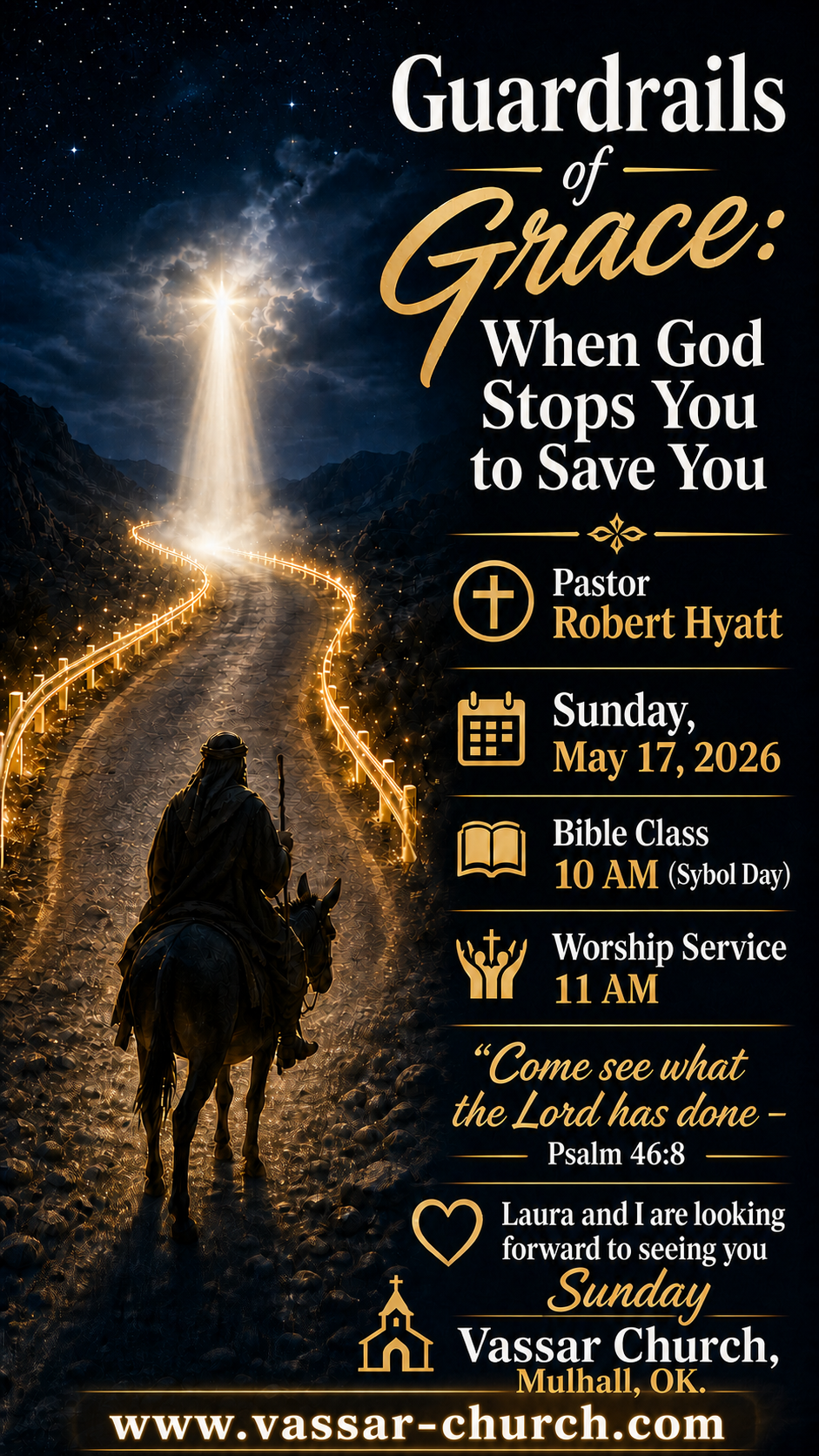
By Pastor Robert Hyatt Sunday 24, 2026
Balaam’s journey began like a promotion, an honor, a doorway to influence. He had been summoned by a king. The rewards were impressive, the promises attractive, and the path ahead looked like success. Yet while Balaam saddled his donkey and set out, heaven saw something very different. What looked to Balaam like opportunity looked to God like a road toward destruction. Scripture records, “Then God’s anger was aroused because he went, and the Angel of the Lord took His stand in the way as an adversary against him” (Numbers 22:22, NKJV). Balaam believed he was moving forward, but God had already taken His stand against the direction of Balaam’s heart.This is where the story begins to speak to us. There are moments when our plans line up, doors swing open, and invitations arrive that feel like confirmation from heaven. Yet the God who sees the end from the beginning knows when a path that looks blessed is actually bending toward danger. In His mercy, He will step into our way. He loves us too much to watch us rush unchallenged toward a cliff.
Mercy That Feels Like Resistance
The Word tells us that as Balaam traveled, something remarkable happened. The donkey he rode could see what Balaam could not. “Now the donkey saw the Angel of the Lord standing in the way with His drawn sword in His hand, and the donkey turned aside out of the way and went into the field” (Numbers 22:23, NKJV). Balaam responded as many frustrated travelers might: he struck the donkey to force it back onto the road. The angel moved ahead to a narrow path between vineyard walls; again the donkey, seeing the danger, pressed against the wall and crushed Balaam’s foot. A third time, in a place so tight there was no room to turn, the donkey simply lay down under him, refusing to move.Three times the animal acted out of character. Three times it resisted the path. Three times Balaam answered not with curiosity, but with anger and violence. Every detour, every painful crush of his foot, every forced stop was actually mercy in disguise. What Balaam interpreted as stubbornness and insult was in fact a desperate attempt to save his life. The very thing he was beating was the one thing standing between him and a drawn sword.How often does God’s mercy come to us wrapped in what feels like resistance? We label delays as “attacks,” call closed doors “failures,” and see frustrating people as “enemies,” all while heaven is actually intervening on our behalf. Our plans run into walls; our feet are “crushed” by circumstances that hem us in; our progress grinds to a halt in narrow places where there is “no way to turn either to the right hand or to the left” (Numbers 22:26, NKJV). Like Balaam, we instinctively strike the nearest “donkey” instead of asking why the path suddenly turned hard.
Misreading God’s Guardrails
This story lays a mirror in front of our hearts. How many times has God placed a barrier in our way, only for us to name it an inconvenience, an attack, or an unfair setback? Balaam did what we often do: he blamed the nearest, most visible thing. Instead of lifting his eyes to ask, “Lord, what are You trying to show me?” he beat the one instrument that was actually keeping him alive.There are seasons when the job that never calls back, the relationship that will not settle into peace, or the move that keeps failing to finalize may be the spiritual equivalent of that donkey stepping off the road. On the surface, these moments feel like rejection and failure. Yet in the light of Numbers 22, they may be “guardrails of grace”—holy interruptions placed there to keep us from an angel with a drawn sword. God’s love is not proven only by doors He opens; it is often proven just as clearly by doors He holds firmly shut.This reframes how we view disappointment. Instead of automatically seeing every “no” as a failure of faith, we can begin to ask new questions: “Lord, are You standing in my way right now? Are You protecting me from something I cannot see? Is this delay a judgment against me—or a rescue for me?” The answer may reveal more of His mercy than we ever imagined.
When Unlikely Voices Speak
Then the story takes an even more surprising turn. “Then the Lord opened the mouth of the donkey, and she said to Balaam, ‘What have I done to you, that you have struck me these three times?’” (Numbers 22:28, NKJV). Suddenly, the least likely voice on the scene becomes the clearest and most reasonable. The donkey reminds Balaam of their long history together, of years of faithful service and steady behavior. “Was I ever disposed to do this to you?” she asks. Balaam, still fuming, has to answer honestly: “No” (Numbers 22:30, NKJV).What is striking is Balaam’s reaction. He answers the donkey as if conversations with animals happen every day. He is so consumed by his anger and his determination to move forward that he does not pause to recognize the miracle in front of him. This is what spiritual dullness looks like: when pride and greed fill the heart, even supernatural intervention can be treated as an irritation instead of a wake-up call. The God who created speech is never limited in how He uses it. He can put His word in any mouth He chooses—even a donkey’s—if His people refuse to listen.Scripture consistently shows that when God’s chosen vessels will not respond, He will raise up other witnesses. Jesus later declared that if His disciples were silent, “the stones would immediately cry out” (Luke 19:40, NKJV). Creation itself is ready to testify when human hearts grow stubborn. In Balaam’s case, a beast of burden became a prophet’s rebuke. In our day, God may use a child’s innocent question, a new believer’s simple insight, or a circumstance that “speaks” louder than any sermon to confront our path.
Eyes Opened at Last
After the donkey’s complaint, the Lord does something even more gracious: He opens Balaam’s eyes. “Then the Lord opened Balaam’s eyes, and he saw the Angel of the Lord standing in the way with His drawn sword in His hand; and he bowed his head and fell flat on his face” (Numbers 22:31, NKJV). Suddenly, everything makes sense. What had seemed like random stubbornness is revealed as faithful obedience to a higher reality. The angel explains, “Behold, I have come out to stand against you, because your way is perverse before Me… If she had not turned aside from Me, surely I would also have killed you by now, and let her live” (Numbers 22:32–33, NKJV).In that moment, the roles are reversed. The animal stands vindicated; the prophet stands exposed. God makes it clear that Balaam’s real problem was not his itinerary, but his heart. His way was “perverse”—twisted and reckless—because greed and ambition were steering his obedience. The drawn sword in the angel’s hand was not a threat without warning; it was a line of mercy that God refused to let him cross unawares.This exposes a sobering truth about the ways of God. There are times when He permits what He does not approve. He may allow us to move toward something we insist upon, not because He endorses it, but because He intends to expose and deal with the motives driving us. Israel once received their request but experienced “leanness” in their souls (Psalm 106:15, NKJV). James warns that we can “ask amiss” to spend God’s blessings on our own pleasures (James 4:3, NKJV). It is possible to push so hard for our own way that God, in judgment and mercy, lets us taste it—and its consequences.
The Danger of Religious Success With a Drifting Heart
Balaam’s story does not end on the road. In the chapters that follow, God restrains his tongue so that he can only bless Israel and even speak beautiful oracles about their future (Numbers 23–24). Outwardly, he sounds like a powerful, accurate prophet. Yet later Scripture reveals that after the public moments were over, Balaam secretly advised Balak to trip Israel through seduction and idolatry. He discovered that if he could not curse God’s people outright, he could still profit by leading them into compromise.The New Testament speaks of “the way of Balaam” and “the doctrine of Balaam”—using his name as a warning for believers who might be tempted to use spiritual gifts or religious influence for personal gain (2 Peter 2:15–16; Revelation 2:14, NKJV). Balaam shows us that it is possible to speak accurately for God in one season and yet drift into manipulation and compromise in another. Outward obedience, impressive words, and visible ministry are not enough if the heart remains unrepentant.This is deeply relevant for our time. In a culture that prizes platform, visibility, and apparent success, Balaam reminds us that God is more concerned with the direction of our hearts than with the size of our influence. A prophet with a gift but no surrendered heart is more dangerous than a donkey with clear vision. In heaven’s accounting, a faithful beast willing to stop is of more value than a gifted leader who refuses to yield.
Humility, Vision, and the “Little” People God Uses
One of the most humbling features of this narrative is that the donkey sees more clearly than the prophet. Spiritual sight is not earned by titles, education, or reputation; it is given to the humble. Jesus rejoiced that the Father reveals His secrets not to “the wise and prudent,” but to “babes” (Matthew 11:25, NKJV). Paul echoes this when he says that God chooses “the foolish things of the world to put to shame the wise” and “the weak things of the world to put to shame the things which are mighty” (1 Corinthians 1:27, NKJV).History confirms this pattern. When the church of Martin Luther’s day had drifted into serious error, it was not the religious elite who first embraced the full implications of the gospel of grace. It was often common men and women—farmers, craftsmen, merchants—who heard the Scriptures preached and recognized that what they were hearing matched the Word of God. Luther’s own declaration that his conscience was “captive to the Word of God” made him, in a sense, a “donkey” on the road, confronting a powerful system that had lost its way. Again, God used what the world considered small to expose what the world considered great.Balaam warns us not to despise the “lesser” voices in our lives. The spouse who raises a quiet concern, the friend who asks a hard question, the child whose words cut through our defenses, the pastor whose sermon hits too close to home—these may be the very instruments God is using to stand in our path. The question is not whether they are as “qualified” as we are, but whether God is speaking through them.
The Pattern of Repeated Warnings
There is also a subtle pattern in the text: the donkey turns aside three times before God opens its mouth. The angel later references these three incidents as a complete testimony that Balaam had been warned thoroughly (Numbers 22:28–33). Throughout Scripture, the number three often marks a full dealing or completed witness—Peter’s three denials and threefold restoration, Jesus’ three prayers in Gethsemane, and so on.In our lives, repeated warnings can function the same way. We hear the same theme in several sermons in a row. Different people, who do not know one another, raise similar concerns. Circumstances seem to circle the same unresolved issue. When that happens, we should pay attention. It may be the Lord establishing a complete witness to our hearts: “I am trying to get your attention. Do not brush this off.”Ignoring these gentle warnings can lead us toward harsher ones. Balaam’s first signal was a detour into a field. The next was a painful crush against the wall. The last was a complete stop in a narrow place. God’s mercy often starts softly. If we resist, He may speak more loudly—not because He enjoys our discomfort, but because He wants to prevent our destruction.
Modern “Donkeys” and Drawn Swords
Imagine, for a moment, a modern version of Balaam’s road. A successful believer is offered a promotion that promises more money and prestige than he has ever seen. The role, however, will pull him away from his family, distance him from church, and require him to bend ethical lines. His spouse expresses concern. His pastor quietly says, “I do not have peace about this.” His own spirit feels unsettled, though he tries to shake it off. As the process moves forward, problems pop up in the paperwork, and unexpected obstacles slow everything down.Each of these is a “donkey moment”—a turn aside, a crush against the wall, a forced stop. Yet if he is set on his own way, he may interpret them only as frustrations to be overcome. He presses harder, silences the uneasy voice of his conscience, and finally pushes past every warning to sign the deal. Only after things collapse does he realize that the very delays he resented were God’s attempts to save him from deeper harm.Our “donkeys” may look like:
- A door that refuses to open no matter how hard we knock.
- A persistent lack of peace in prayer.
- Counsel from trusted believers that challenges our plans.
- Physical exhaustion and stress that warn we are pushing beyond grace.
In each case, the question is not, “How quickly can I get past this?” but, “Lord, are You standing here with a drawn sword for my protection?”
Pride, Trust, and the Safer Path
The Word is clear: “Pride goes before destruction, and a haughty spirit before a fall” (Proverbs 16:18, NKJV). Pride caused Balaam to ignore divine warnings. Pride caused religious leaders to reject their Messiah even as He rode into Jerusalem on a donkey in fulfillment of prophecy (Matthew 21:5; Luke 19:40, NKJV). Pride causes us to disregard counsel, belittle obstacles, and run past the very guardrails God has erected for our good.Yet Scripture also gives us a better way: “Trust in the Lord with all your heart, and lean not on your own understanding; in all your ways acknowledge Him, and He shall direct your paths. Do not be wise in your own eyes; fear the Lord and depart from evil” (Proverbs 3:5–7, NKJV). Trust is the opposite of self-reliance. It is the posture that says, “Lord, I would rather be delayed by Your mercy than destroyed by my stubbornness. I would rather lose what I thought was my opportunity than lose my soul.”There will be seasons when God closes doors we desperately want open. Some prayers will not be answered the way we hoped. Carefully laid plans will fall apart. When that happens, the question that echoes from Balaam’s donkey is, “Was I ever disposed to do this to you?” In other words, “Has God ever been unfaithful to you? Has He misled you before?” The honest answer is no. Looking back, we often see that His refusals and redirections were woven into a larger tapestry of mercy.
Listening While It Is Still Day
The invitation of this story is both simple and searching: listen to the donkey in your life. Pay attention to the humble voices, the uncomfortable interruptions, the circumstances that resist your rush toward what you think you must have. Instead of beating against them in anger, bring them before the Lord and ask, “Father, are You speaking to me through this? Are You standing in my way because You love me and see what I cannot see?”If you recognize that you have been walking in the way of Balaam—loving the “wages of unrighteousness,” using spiritual things for selfish ends, or pushing past repeated warnings—this story is not just a rebuke; it is an invitation. The very fact that God is confronting you shows that He has not abandoned you. He is still on the road, sword drawn—not because He hates you, but because He loves you too much to let you go unchallenged.If you will humble yourself, turn from pride, and surrender your path back to Him, He will guide you into life. He will take the reins of your journey. What once looked like painful loss will, in time, become a testimony of His saving power and wise, protective love.